
A!Planner is a solution that uses AI to optimize work scheduling and similar processes.
By finding the best possible schedule and guiding the people who carry it out, it makes operations more efficient, reduces costs and helps prevent accidents.
-
-
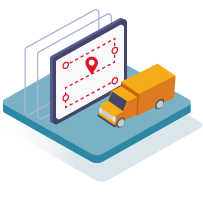
Route Optimization
A!Planner provides the best possible route plan, cutting costs and making the work of your staff more efficient.
Planning and monitoring the optimal route for the conditions - where a truck picks goods up, where it delivers them - raises the efficiency of the whole operation.
-
-
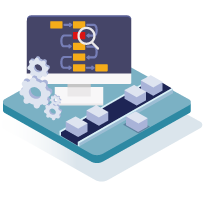
Load Optimization
Load optimization is one of A!Planner's core capabilities: it calculates in real time how to leave as little empty space as possible, drawing on the shape of the items picked, how they were picked and the space available in the container.
It plans and proposes the best way to load given the size, weight and number of items and the pick-up conditions at each delivery point.
-
-
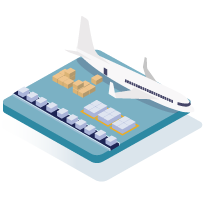
Air Cargo Optimization
For air cargo, A!Planner plans the loading order and position of each ULD.
The plan reflects the characteristics of every ULD, with the aim of holding the aircraft's center of gravity, minimizing fuel burn and making the loading work itself more efficient.
-

-
Process Optimization
A!Planner combines solver technology with modeling of the problem domain to achieve more than 20% process optimization. Where other planning technologies slow down as constraints multiply, A!Planner completes the optimization within the time available.
A!Planner is an AI planning solution that derives the fullest load and the best route in the shortest possible time.
-

-
Our Own Planning Engine
A!Planner selects the algorithm best suited to solving your problem under the constraints you have set. Expert know-how has been gathered and applied to heuristic algorithms, which makes it widely applicable.
-
-
Optimal Process Results
A!Planner can produce optimal process results across many industries. It applies wherever work has to be completed within a fixed time - dispatch optimization, route finding, berthing and departure planning and more.
-

-
Usability
If a process changes partway through, the change is taken into account automatically: the plan is redrawn and the new optimal schedule is issued. Results are produced so that the people doing the work are never held up.
-
-
Tree Algorithms and Knowledge, Combined
Experience of a problem and the conditions around it are turned into rules and accumulated as a knowledge base, which then informs the search decisions - producing more accurate process results.

- Efficiency
The logistics optimization solution manages the whole distribution center as one and optimizes its resources, improving the logistics process end to end.
In port operations it works out the most efficient order and method for handling the containers aboard a vessel, and controls the quay cranes (QC) accordingly.
It decides where to stack containers for efficient block operation in the yard and optimizes loading and unloading, driving the yard cranes (YC).
At any given moment it decides which yard truck (YT) to assign to which QC and YC task, given how each machine is working, and routes it by the shortest path.

- Speed
To handle the inbound and outbound work of external trucks efficiently, the system plans the order in which trucks enter and leave and the work inside the yard.
It minimizes congestion between the paths taken by external trucks and yard trucks (YT) and the yard crane (YC) work within a block, so that a truck reaches the right YC by the most efficient path, and it settles the best order of work.
The result is the shortest possible turnaround time and a faster process overall.

- Economy
Optimizing the movement and flow of cargo makes a high-efficiency, low-cost service possible.
Beyond the saving in operating costs, IT management and the control and operation of automated equipment create new jobs.
Electrifying equipment and optimizing movement within the port minimize emissions, so an environmentally sound port can be built.

A!Planner in operation at Busan Port Authority.
In the previous terminal operating system most of the work relied on visual checks and on unstructured measurement and handling - on the intuition and experience of the operators - and much of it was not especially efficient.
Since A!Planner was introduced, picking can be done in advance, and when cargo is loaded onto a vehicle the loading order and position the solution proposes allow it to be done with the least work and along the best route, which has cut both cost and time substantially.