


-
A logistics system built on AI achieves optimal efficiency in the movement of goods.
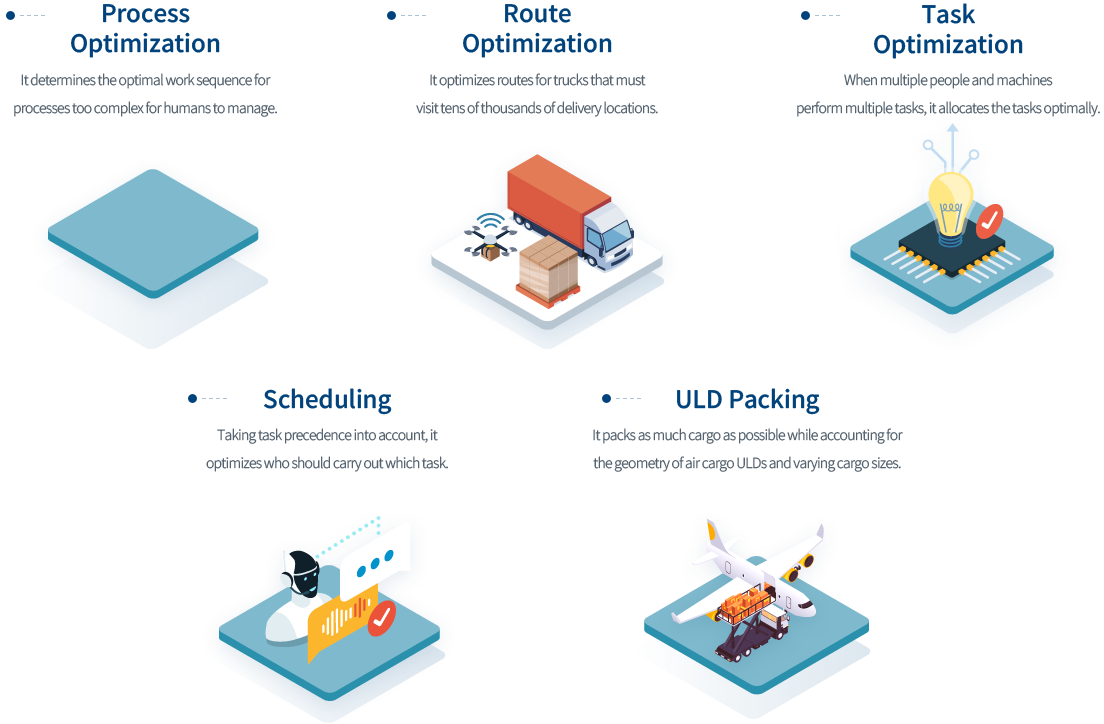
A logistics company may operate hundreds of delivery trucks that collect and deliver parcels to tens of thousands of households.
AI planning can find optimal routes that satisfy complex constraints such as weight limits, restricted delivery times and required delivery time windows,
minimizing travel distance and time while maximizing operational efficiency. -
It helps you optimize the way goods are loaded into containers and trucks.
An air cargo ULD has one corner cut away, which makes it difficult to load cargo of many different sizes and shapes efficiently.
AI planning technology helps determine packing arrangements that maximize cargo utilization. -
It automates work scheduling across business processes, distributes tasks among workers and finds the optimal working times.
Determining which nurse should be assigned to which patient, which pilot should operate a particular flight,
or which virtual machine should run a specific application in the cloud can be highly complex. In particular, manufacturing and construction processes
often require strict precedence constraints, where certain tasks must be completed before others can begin. A!Planner effectively handles
these challenges by finding optimal schedules while satisfying all given constraints.
Value Proposition
More than 75% of global logistics passes through ports.
Containers alone account for more than 80% of all port logistics, and demand keeps growing.
To handle port containers more efficiently, AI planning can take over even problems too complex for people to solve.
A!Planner delivers best-in-class performance and accuracy across every aspect of port container handling.


